
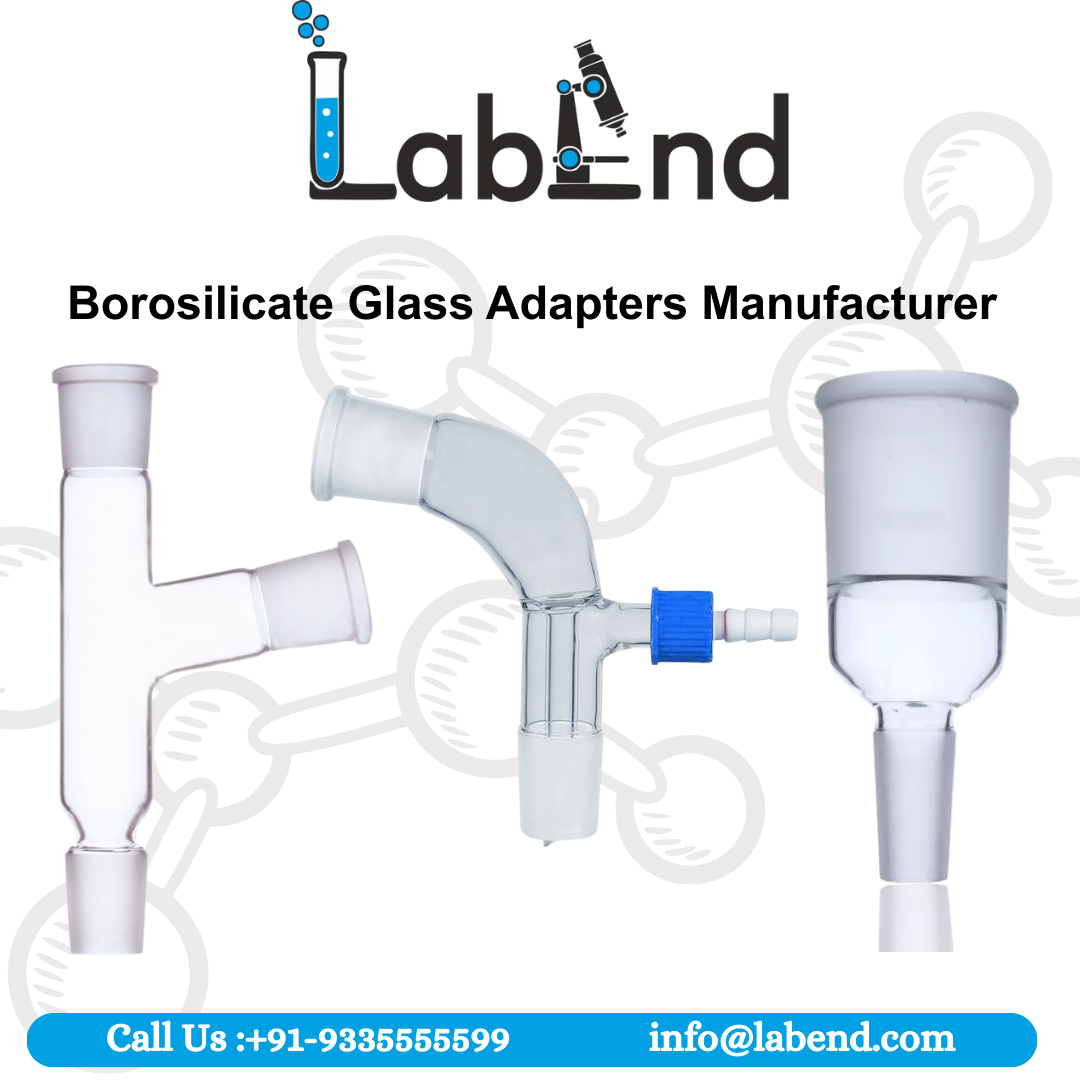
Borosilicate Glass Adapters Manufacturer
In the sophisticated world of chemical synthesis and pharmaceutical research, the modularity of your laboratory setup often dictates the speed of your results. While flasks and condensers are the primary players, it is the humble adapter that creates the vital link between different components. As a leading Borosilicate Glass Adapters Manufacturer, our focus is on creating these high-precision links that ensure airtight connectivity and thermal stability. Without these adapters, assembling complex distillation units or vacuum filtration systems would be an impossible task.
India has emerged as a global hub for scientific glassware, and the demand for high-quality adapters has grown alongside the expansion of our biotech and industrial sectors. Choosing the right manufacturer ensures that your laboratory remains a safe, efficient, and productive environment.
The Science Behind the Choice: Why Borosilicate 3.3?
Not all glass is created equal. A professional Borosilicate Glass Adapters Manufacturer exclusively uses Borosilicate 3.3 glass, which is characterized by its high silica and boron trioxide content. This specific composition provides a very low coefficient of thermal expansion, meaning the glass does not expand or contract significantly when exposed to rapid temperature changes.
In a laboratory where you might be moving a reaction from a heating mantle to an ice bath, the thermal shock resistance of your glass adapters is a non-negotiable safety requirement. Furthermore, this glass is chemically inert, preventing any leaching of impurities into your sensitive chemical samples.
Precision Shaping: The Manufacturing Process
The creation of a glass adapter is a meticulous blend of science and craftsmanship. As a dedicated Borosilicate Glass Adapters Manufacturer, we employ skilled glassblowers and automated machinery to ensure every joint meets international standards.
1. Raw Material Preparation
The process begins with selecting high-purity silica sand and boron oxide. These are melted in high-temperature furnaces to create the master glass tubes that serve as the base for all our adapters.
2. Precision Grinding
The "joints" of an adapter are the most critical part. We use precision grinding techniques to create standard taper joints (such as 14/23 or 24/29). These ground-glass joints must be perfectly smooth to ensure a leak-proof seal without the need for excessive grease, which can contaminate the reaction.
3. Annealing for Strength
Once shaped, every adapter undergoes a controlled cooling process called annealing. This relieves internal stresses in the glass, making it significantly more durable and resistant to mechanical impact.
Versatility in the Catalog: Types of Glass Adapters
A versatile Borosilicate Glass Adapters Manufacturer must cater to a wide range of experimental needs. Our inventory includes:
-
Reduction and Enlarging Adapters: These are used to connect two glass joints of different sizes. For example, connecting a 24/29 condenser to a 14/23 flask.
-
Distillation Adapters: Including Still Heads and Claisen Heads, these are designed to facilitate the flow of vapor during distillation while providing ports for thermometers.
-
Vacuum Adapters: Equipped with hose connections, these allow for the evacuation of air from a system, which is essential for vacuum distillation or inert gas shielding.
-
Receiver Adapters: Used to guide the distillate into the collection flask, available in both straight and bent configurations.
Role in Pharmaceutical and Research Excellence
In the pharmaceutical industry, particularly in the production of Active Pharmaceutical Ingredients (APIs), the integrity of the glassware setup is paramount. As a leading Borosilicate Glass Adapters Manufacturer, we provide the specialized adapters needed for reflux reactions and solvent recovery.
Our adapters are designed to withstand prolonged exposure to aggressive solvents like concentrated acids and alkalis at high temperatures. The non-porous surface of our borosilicate glass ensures that there is no residue absorption, facilitating easy cleaning and preventing cross-contamination between different batches of research.
Compliance and Global Quality Standards
The mark of a world-class Borosilicate Glass Adapters Manufacturer is its adherence to international quality protocols. Our products are manufactured in compliance with ISO 3819 and DIN standards, ensuring that every joint is interchangeable with any standard laboratory system globally.
Every batch of glassware undergoes rigorous quality checks, including dimensional accuracy using digital calipers and thermal stress testing. This commitment to quality is why our glass adapters are exported to laboratories across the United States, Europe, and the Middle East, representing the best of Indian engineering.
Sustainability: Glass as the Ethical Choice
As laboratories move toward "Green Chemistry," the choice of material becomes a statement of ethics. Unlike single-use plastics, borosilicate glass is indefinitely reusable and fully recyclable. By investing in high-quality adapters from a reputable manufacturer, labs reduce their environmental footprint while benefiting from the superior performance that only glass can provide.
Maintenance and Care for Glass Adapters
To get the most out of your high-precision glassware, consider these maintenance tips:
-
Avoid Excessive Grease: Use only a thin film of vacuum grease on ground joints. Over-greasing can lead to contamination.
-
Regular Inspection: Always check for minor chips or "star cracks" before using an adapter under vacuum or heat.
-
Proper Cleaning: Use ultrasonic cleaners or non-abrasive detergents to maintain the clarity and smoothness of the ground joints.
Conclusion: Connecting the Future of Science
The progress of science relies on the reliability of the tools we use. As a premier Borosilicate Glass Adapters Manufacturer, we are proud to provide the connectivity that makes modern research possible. From the smallest university lab to the largest industrial plant, our glass adapters serve as the silent, sturdy links in the chain of discovery. By choosing precision, durability, and chemical resistance, you are choosing a future where your experimental data is always accurate and your lab is always safe.
Unique Technical FAQ
Q1: What does "Borosilicate 3.3" actually mean in terms of performance?
The "3.3" refers to the linear coefficient of thermal expansion, which is $3.3 \times 10^{-6}\text{ K}^{-1}$. In simple terms, this means the glass expands about one-third as much as ordinary soda-lime glass when heated. This makes it exceptionally resistant to cracking when exposed to extreme temperature gradients.
Q2: Can these adapters be used for high-vacuum applications?
Absolutely. As long as the ground-glass joints are properly matched and a high-quality vacuum grease or PTFE sleeve is used, our adapters are designed to hold vacuums down to $10^{-3}\text{ mbar}$ without leakage.
Q3: Is it safe to use these adapters with hydrofluoric acid?
No. While borosilicate glass is highly resistant to almost all chemicals, hydrofluoric acid (HF) and hot concentrated phosphoric acid are exceptions that will chemically attack and etch the glass surface, compromising its structural integrity.



Leave a comment