
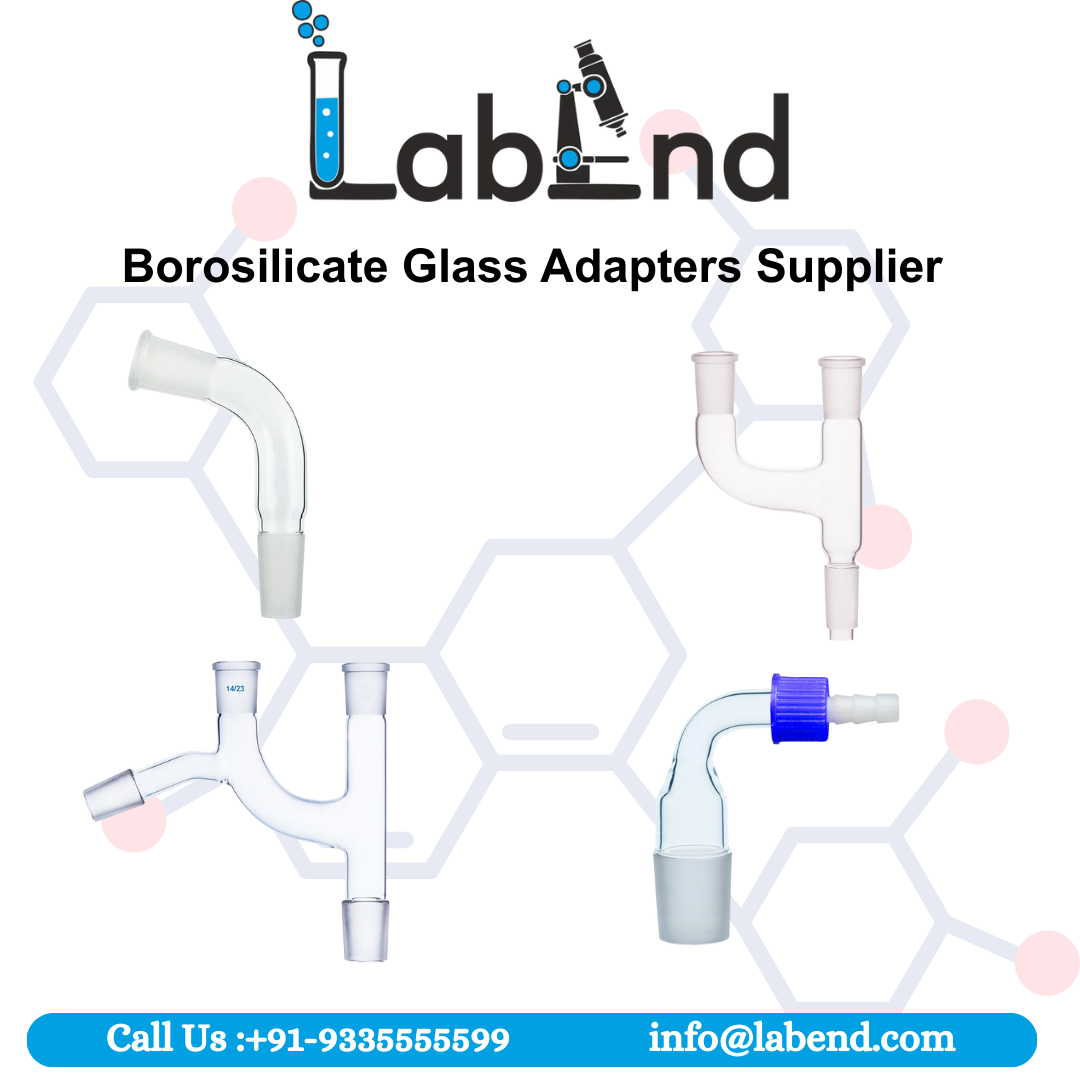
Borosilicate Glass Adapters Supplier
In the complex landscape of chemical synthesis, the success of an experiment often hinges on the seamless integration of various components. While reactors and condensers are the "muscles" of a setup, the adapters are the "connectors" that make the entire system functional. Finding a reliable Borosilicate Glass Adapters Supplier is not just about purchasing a piece of glass; it is about securing the integrity of your entire scientific workflow. Whether you are performing a simple solvent recovery or a multi-stage organic synthesis, the quality of your adapters determines the safety and precision of your results.
As laboratories across India and the globe move toward more complex and modular designs, the role of a specialized supplier has become more critical than ever. High-quality borosilicate 3.3 adapters provide the thermal stability and chemical inertness required to handle the most aggressive reagents and extreme temperature gradients.
Why Borosilicate 3.3 is the Gold Standard for Adapters
When you partner with a reputable Borosilicate Glass Adapters Supplier, the first thing they will highlight is the material grade. Borosilicate 3.3 glass is renowned for its low coefficient of thermal expansion ($3.3 \times 10^{-6}\text{ K}^{-1}$). This physical property ensures that when a glass adapter is exposed to sudden heat—such as during a distillation process—it does not crack due to thermal shock.
Furthermore, borosilicate glass is highly resistant to water, neutral and acid solutions, concentrated acids and their mixtures, as well as to chlorine, bromine, iodine, and organic matters. This chemical resistance ensures that the adapter does not leach impurities into your sample, maintaining the high purity levels required in pharmaceutical and analytical research.
Precision Engineering: The Mark of a Great Supplier
Manufacturing a glass adapter is a delicate process that requires both artisanal skill and industrial precision. A top-tier Borosilicate Glass Adapters Supplier ensures that every product undergoes rigorous quality control.
The most critical part of any adapter is the "ground glass joint." These joints (standardized as Cone and Socket) must be ground with microscopic precision to ensure a vacuum-tight seal. Any irregularity in the grinding can lead to vapor loss during distillation or, worse, the accidental implosion of a system under vacuum. Quality suppliers use diamond-grinding technology to achieve a surface finish that allows for a "snug" fit, minimizing the need for heavy grease and reducing the risk of joint "seizing."
A Versatile Catalog: Serving Every Laboratory Need
A comprehensive Borosilicate Glass Adapters Supplier should offer a wide variety of configurations to support diverse experimental designs. Some of the essential adapters include:
-
Reduction and Expansion Adapters: Essential for connecting glassware of different joint sizes (e.g., connecting a 14/23 flask to a 24/29 condenser).
-
Multiple Adapters: Featuring two or three necks (parallel or at 45° angles), these allow for the simultaneous insertion of thermometers, addition funnels, and gas inlets into a single flask.
-
Vacuum and Gas Inlet Adapters: Designed with hose connections or stopcocks to allow for the evacuation of air or the introduction of inert gases like Nitrogen or Argon.
-
Distillation Heads and Receiver Adapters: Specifically engineered to direct vapors and liquids efficiently during purification processes.
Customization: The Competitive Edge
Often, a standard off-the-shelf component isn't enough for specialized research. A leading Borosilicate Glass Adapters Supplier will offer custom glass-blowing services. Whether you need a specific angle for a side-arm, a non-standard joint size, or a jacketed adapter for temperature-sensitive transfers, a supplier with an in-house glass-blowing facility can turn technical drawings into high-performance reality. This flexibility is what allows research institutions to push the boundaries of what is possible in the lab.
Compliance with Global Quality Standards
Trust in a supplier is built on certification. When sourcing laboratory glassware, always look for compliance with international standards such as ISO 3819 (for beakers and flasks) and DIN 12257 (for ground joints). An ISO-certified Borosilicate Glass Adapters Supplier ensures that their products are interchangeable with any global glassware brand, providing you with a seamless experience when upgrading your existing lab inventory.
Furthermore, every batch of glassware should be "stress-free." Suppliers achieve this through a process called annealing, where the glass is heated and then cooled very slowly in a lehr (a specialized oven). This eliminates internal stresses that could lead to spontaneous breakage during use, ensuring the long-term safety of your laboratory personnel.
Maintenance and Best Practices for Long-Lasting Glassware
To maximize the value of your investment, it is important to handle your adapters with care:
-
Joint Care: Always use a very thin film of specialized vacuum grease or PTFE sleeves to prevent joints from sticking (freezing).
-
Cleaning: Use non-abrasive detergents and avoid harsh scrubbing, which can scratch the glass and create stress points.
-
Visual Inspection: Before starting any experiment, especially those involving vacuum or heat, inspect your adapters for "star cracks" or chips. A damaged adapter should be discarded or sent for repair immediately.
Conclusion: The Strategic Value of a Reliable Partner
In the scientific world, your results are only as good as the tools you use. Choosing a dedicated Borosilicate Glass Adapters Supplier is a strategic decision that affects the safety, efficiency, and accuracy of your research. By opting for high-purity borosilicate 3.3, precision-ground joints, and a supplier who understands the nuances of custom requirements, you ensure that your laboratory is equipped to handle the challenges of modern chemistry. At the end of the day, these small glass connectors are the silent partners in your journey toward scientific breakthrough, providing the stability and connectivity your innovation deserves.
Frequently Asked Questions (FAQ)
Q1: What is the difference between a 'Reduction' and an 'Expansion' adapter?
A reduction adapter is used when you need to fit a smaller "cone" (male joint) into a larger "socket" (female joint). Conversely, an expansion adapter allows you to fit a larger cone into a smaller socket. Essentially, they serve as the "step-up" or "step-down" transformers of the glassware world, ensuring different sizes of equipment can work together seamlessly.
Q2: Can I use borosilicate adapters for high-pressure reactions?
While borosilicate glass is incredibly strong, it is generally designed for vacuum and atmospheric pressure. For high-pressure reactions, specialized "Pressure Vessels" or metal reactors are usually required. Using standard glass adapters under high pressure is dangerous and can lead to catastrophic failure (explosion). Always check the pressure rating provided by your Borosilicate Glass Adapters Supplier.
Q3: How do I choose between a 2-way and a 3-way 'Multiple Adapter'?
The choice depends on the number of "tasks" you need to perform on a single flask. If you only need to add a thermometer to a distillation setup, a 2-way adapter is sufficient. However, if you need to add reagents while simultaneously monitoring the temperature and purging the system with nitrogen, a 3-way or 4-way adapter (often called a Claisen adapter) is necessary to provide the required number of ports.



Leave a comment