

Laboratory Plasticware Manufacturer in India : Labend
In the modern era of high-throughput screening and molecular diagnostics, the reliance on advanced polymers has surpassed traditional materials in many laboratory applications. Precision, safety, and disposability are no longer luxury requirements—they are the standards. As a leading Laboratory Plasticware Manufacturer in India, our mission is to provide researchers with high-performance tools that bridge the gap between cost-efficiency and scientific integrity. From DNA amplification to routine chemical storage, the right plasticware is the unsung hero of the scientific world.
The Paradigm Shift: Why Plasticware is Replacing Traditional Media
For decades, glass was the undisputed king of the laboratory. However, the rise of biotechnology and clinical diagnostics necessitated materials that are shatterproof, lightweight, and capable of being manufactured with microscopic precision. A world-class Laboratory Plasticware Manufacturer in India utilizes medical-grade polymers like Polypropylene (PP), High-Density Polyethylene (HDPE), and Polystyrene (PS). These materials offer unique benefits:
-
Safety: Reduced risk of injury from breakage, especially when handling biohazardous samples.
-
Chemical Resistance: High tolerance to a wide range of acids, bases, and organic solvents.
-
Purity: Advanced manufacturing in Clean Room environments ensures that the products are free from DNase, RNase, and pyrogens.
Precision Engineering: The Manufacturing Lifecycle
Manufacturing scientific plasticware is an exercise in extreme accuracy. Unlike domestic plastic products, labware must adhere to strict dimensional tolerances. The process involves:
1. High-Tech Injection Molding
Every tip, tube, and beaker starts with high-precision molds. As a dedicated Laboratory Plasticware Manufacturer in India, we invest in Swiss-made or Japanese-engineered molds that ensure wall thickness is uniform. This uniformity is critical for even heat transfer during PCR or centrifugation.
2. Medical-Grade Raw Materials
We only use "Virgin" medical-grade resins. These resins do not contain recycled content or heavy metal additives, ensuring that there is zero leaching of chemicals into your sensitive biological samples.
3. Surface Treatment Technologies
For applications like cell culture, the plastic surface must be treated to allow for cell attachment. Conversely, for low-retention pipette tips, we employ hydrophobic surface technologies that ensure maximum liquid recovery, saving expensive reagents.
Comprehensive Product Range for the Modern Lab
A versatile Laboratory Plasticware Manufacturer in India must cater to a spectrum of scientific disciplines. Our inventory includes:
-
Liquid Handling: Pipette tips (filter and non-filter), microcentrifuge tubes (MCTs), and reagent reservoirs.
-
Sample Storage: Cryovials with internal or external threads, storage boxes, and deep-well plates.
-
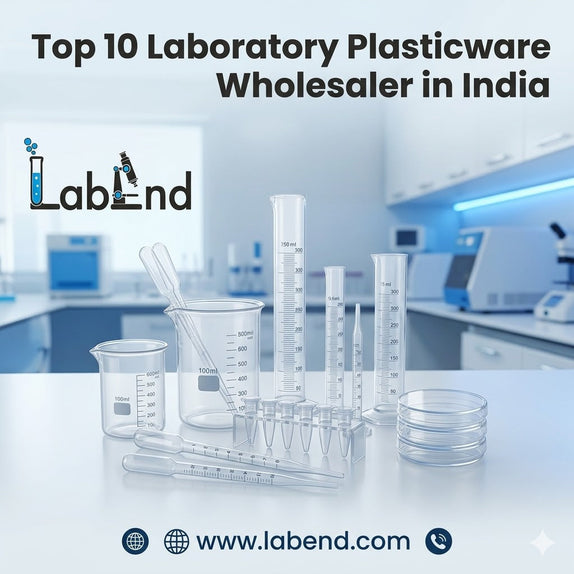
General Labware: Graduated cylinders, beakers, funnels, and wash bottles that provide clear visibility and accurate measurements.
-
Clinical Diagnostics: Urine containers, petri dishes, and specimen swabs designed for aseptic collection.
The Role of Plasticware in Molecular Biology and Genomics
In the world of genomics, the smallest contamination can ruin weeks of research. Our PCR tubes and plates are designed with ultra-thin walls to facilitate rapid and uniform thermal transfer. Being a specialized Laboratory Plasticware Manufacturer in India, we understand that "clear" is not just a color—it is a requirement for optical clarity in Real-Time PCR. Our high-transparency plastics allow for precise fluorescence detection, ensuring that your data is as accurate as your science.
Sustainability in Science: The Move Toward Eco-Friendly Plasticware
The environmental impact of single-use plastics is a major concern for the global scientific community. We are leading the way by developing "Thin-Wall" technology that reduces plastic consumption by up to 20% without compromising strength. Additionally, our polypropylene products are 100% recyclable, and we advocate for laboratory recycling programs to ensure a circular economy in science.
Global Quality Compliance and Certifications
The strength of a Laboratory Plasticware Manufacturer in India lies in its ability to compete on the global stage. Our manufacturing facilities are ISO 9001 and ISO 13485 certified, meeting the rigorous standards for medical device manufacturing. Every batch undergoes stringent quality control tests, including:
-
Leakage Tests: To ensure airtight seals in centrifuge tubes.
-
Centrifugation Stability: Testing tubes at RCF values exceeding 20,000 x g.
-
Autoclave Validation: Ensuring products can withstand 121°C without deformation.
Maintenance and Best Practices for Lab Plasticware
While plastic is durable, its lifespan and performance depend on proper handling:
-
Chemical Compatibility: Always check if your specific polymer is resistant to the chemical you are using (e.g., avoid using Polystyrene with strong organic solvents).
-
Autoclaving: Only autoclave products marked as "Autoclavable." Ensure caps are loosened to allow steam circulation.
-
Visual Inspection: Discard any plasticware that shows signs of "crazing" (fine cracks), as these can harbor contaminants or fail under pressure.
Conclusion:
The landscape of scientific research is shifting toward faster, safer, and more accurate methodologies. As a premier Laboratory Plasticware Manufacturer in India, we are at the forefront of this transition. By combining advanced polymer engineering with a deep understanding of laboratory workflows, we provide the essential tools that allow scientists to push the boundaries of what is possible. Whether you are conducting a simple titration or an intricate gene-editing experiment, our plasticware provides the reliable foundation your research deserves.
Frequently Asked Questions (FAQ)
Q1: What is the difference between Polypropylene (PP) and Polyethylene (PE)? Polypropylene is more rigid and has a higher melting point, making it autoclavable and ideal for centrifuge tubes. Polyethylene is more flexible and is often used for wash bottles and disposable droppers.
Q2: Are your pipette tips universal fit?
Yes, as a leading manufacturer, we design our pipette tips to be compatible with most major global brands like Eppendorf, Gilson, and Thermo Fisher.
Q3: Can lab plasticware be reused?
While many items like beakers and cylinders are designed for multiple uses after proper sterilization, items like pipette tips and PCR tubes are strictly single-use to prevent cross-contamination.
Q4: Do you provide bulk customization or OEM services?
Yes, we offer custom molding and private labeling for large-scale research institutions and diagnostic kit manufacturers worldwide.

Leave a comment