

Student Microscope: Types, Diagram & Complete Guide
By Labend | Leading Student Microscope Manufacturer in India Since 1978
1. Introduction
A student microscope is a precision optical instrument designed specifically for educational use. It allows students to observe specimens at magnified levels that are not visible to the naked eye. From examining plant cells in a biology class to studying microorganisms in a laboratory practical, this instrument sits at the center of science education across every level.
In India, science education depends heavily on well-equipped laboratories. Schools and colleges that provide students with functional, reliable microscopes give them a direct advantage in understanding biological concepts. Hands-on learning through microscopy builds observational skills, analytical thinking, and a genuine interest in the sciences.
Labend has been manufacturing top-tier optical and laboratory instruments from India since 1978. Over four decades of production experience, institutional supply, and quality engineering make Labend one of the most trusted names in educational microscopy across the country. This article provides an in-depth reference for institutions, procurement officers, and educators evaluating microscope options for their laboratories.
2. What is a Student Microscope?
A student microscope is a compound optical instrument that uses two or more lenses to magnify specimens mounted on glass slides. It typically offers a magnification range of 40x to 400x, which covers the majority of educational observation requirements at the school and undergraduate level.
Unlike research-grade microscopes, which can cost several lakhs and offer magnification beyond 1000x along with phase contrast, fluorescence, or confocal imaging capabilities, the student microscope is built for durability, simplicity, and affordability.
Key Differences at a Glance
-
Research Microscopes: Calibrated for specialist use, require trained operators, and offer complex imaging modes.
-
Student Microscopes: Designed so that a learner with basic instruction can set up a slide, focus the lens, and make observations within minutes. It does not compromise on optical quality but does eliminate features that are irrelevant at the classroom level. The focus is entirely on function: clear imagery, ease of use, and resistance to heavy handling.
3. Student Microscope Diagram: Parts and Their Functions
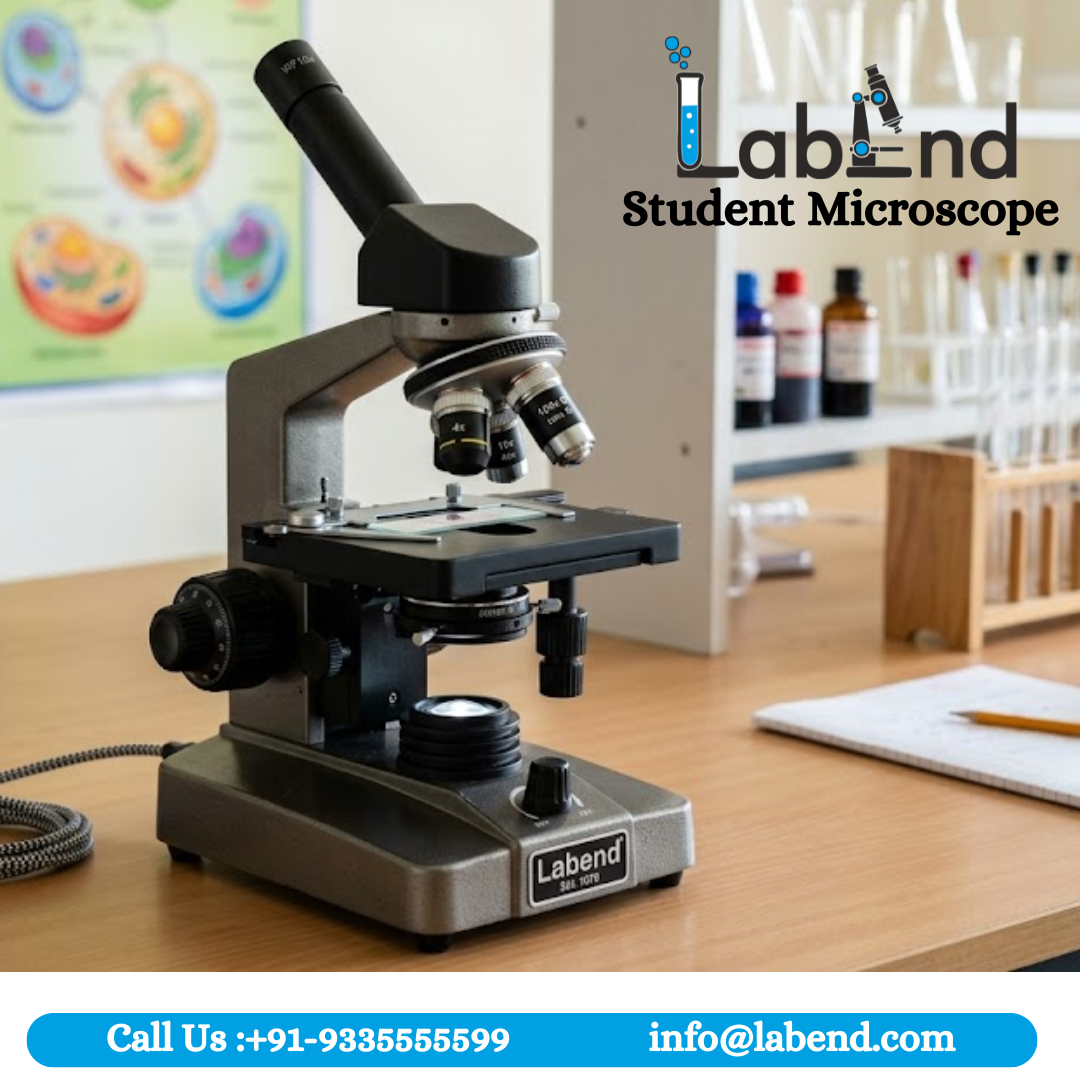
Understanding a student diagram of a microscope is the first step in learning how to use one correctly. Each component has a specific role, and knowing the function of every part helps students operate the instrument with confidence and prevents accidental damage.
-
Eyepiece (Ocular Lens): The lens through which the observer looks. In most student microscopes, it carries a magnification of 10x. Some premium models offer a wider field of view eyepiece (WF10x or WF15x), making it much easier for students to locate specimens.
-
Objective Lenses: Mounted on a rotating nosepiece, these come in three or four magnifications: 4x, 10x, 40x, and sometimes 100x (oil immersion). Rotating the nosepiece increases magnification but reduces the field of view. Most school-level biology work relies on 10x and 40x objectives.
-
Stage: The flat platform where the specimen slide is placed. Basic models use metal stage clips, while higher-specification models feature a mechanical stage that allows users to move the slide precisely using X and Y axis knobs.
-
Coarse and Fine Adjustment Knobs: Located on the arm, these control vertical movement. The larger coarse knob is used for initial rough focusing, while the smaller fine adjustment knob brings the specimen into sharp, crisp focus.
-
Light Source: Modern instruments feature a built-in LED or halogen light source at the base rather than older reflective mirrors. LED illumination is highly preferred as it produces consistent, cool white light and consumes minimal power.
💡 Pro-Tip: A standard microscope diagram also identifies the arm (used for carrying), the heavy stable base, the body tube (holding the eyepiece), and the condenser with an iris diaphragm beneath the stage to control light intensity.
4. Types of Student Microscopes
Different educational settings require different configurations. Here is a breakdown of the models available for institutional labs:
Monocular Student Microscope
Featuring a single eyepiece, this is the most economical option. It is lightweight, compact, and perfectly suited for primary and secondary school laboratories where basic cell observation is the goal.
Binocular Student Microscope
Equipped with two eyepieces, this model allows both eyes to be used simultaneously, drastically reducing eye strain. It is highly recommended for senior secondary and undergraduate college labs where students spend extended hours on practicals.
Digital Student Microscope
Featuring a built-in camera that connects directly to a computer, monitor, or interactive smartboard. It allows an entire class to view the same specimen simultaneously, making it an excellent asset for modern smart classrooms and group demonstrations.
Compound Student Microscope
The gold standard for Indian schools and colleges. Using a two-lens system (eyepiece + objective), compound microscopes are highly versatile and ideal for observing tissues, bacteria, fungi, and standard curricular specimens.
5. Key Features of a High-Quality Microscope
When evaluating microscopes for institutional procurement, look out for these essential parameters:
-
Magnification Range: Ensure it offers at least 40x to 400x curriculum coverage. Advanced microbiology labs should look for models expandable to 1000x with oil immersion.
-
Optical Clarity: Insist on DIN-standard (Deutsche Industrie Norm) glass lenses with anti-reflection coatings to reduce glare and enhance color contrast.
-
Rugged Build Quality: The body frame must be made of die-cast metal or heavy alloys, never plastic. Heavy institutional use demands a frame that resists physical shocks and laboratory chemicals.
-
Coaxial Focusing: Models featuring integrated coaxial coarse-and-fine focus systems prevent students from accidentally grinding the objective lens into the glass slide.
6. Applications in Education
-
School Laboratories (Class 6 to 12): Essential for introducing fundamental topics like cell structures, tissue differentiation, and basic botany/zoology under CBSE, ICSE, and State Boards.
-
College and University Laboratories: Designed for advanced degree courses in Microbiology, Biotechnology, and Botany requiring high optical fidelity and continuous, long-duration practical work.
-
Medical & Paramedical Training: Utilized extensively by nursing and pharmacy institutes for identifying blood cells, tissue samples, and microbial cultures.
7. How to Use a Student Microscope: Step-by-Step
-
Step 1: Setup — Place the microscope on a flat surface. Always carry it with two hands: one gripping the arm, and the other supporting the base. Rotate to the lowest objective lens (4x or 10x) before inserting a slide.
-
Step 2: Slide Placement — Center your slide over the stage aperture and secure it firmly with the stage clips. Turn on the LED light source.
-
Step 3: Initial Focusing — Looking from the side, lower the objective close to the slide using the coarse knob. Then look through the eyepiece and turn the knob slowly until a rough image appears.
-
Step 4: Fine Tuning — Use the fine adjustment knob to bring the specimen into razor-sharp focus. If you need higher magnification, swing the nosepiece to the next objective and adjust only the fine focus knob.
8. Buying Guide & Institutional Specifications
Procurement decisions should be driven by build material and optical clarity rather than price alone. A cheap plastic microscope that breaks down in two terms costs significantly more over time than a well-built instrument that lasts decades.
Recommended Specifications for School & College Labs
| Component | Recommended Specification |
| Eyepiece | Wide-Field WF10x or WF15x |
| Objectives | 4x, 10x, 40x (DIN Standard) |
| Total Magnification | 40x to 400x (Up to 1000x for colleges) |
| Illumination | Cool-white, energy-efficient LED with intensity control |
| Stage Mechanism | Fixed with spring clips (Mechanical stage for college-level) |
| Body Frame | Heavy-duty, die-cast metal alloy |
| Focus Mechanism | Coaxial coarse and fine adjustment knobs |
9. Why Choose Labend as Your Microscope Partner in India
Choosing the right manufacturer directly impacts your long-term maintenance, availability of spare parts, and warranty support. Labend stands out for several reasons:
-
Four Decades of Engineering Excellence: Since 1978, Labend has supplied robust microscopy solutions across India. Our instruments are uniquely engineered to withstand regional challenges like voltage fluctuations and high tropical humidity.
-
Domestic Production, Honest Pricing: As a direct manufacturer in India, Labend eliminates hefty import duties, offering highly competitive pricing, quick delivery turnarounds, and easily accessible local components.
-
Rigorous Quality Control: Every single student microscope undergoes thorough mechanical alignment and optical testing before dispatch, ensuring uniform performance across bulk shipments.
-
Distributor Support: We offer structured bulk pricing, technical documentation, and demonstration units to our authorized dealers and B2B distributors nationwide.
10. Maintenance and Care Tips
A well-maintained Labend microscope can easily serve an educational laboratory for 15 to 20 years. Follow these core practices:
-
Optical Care: Wipe lenses using only dedicated lens tissue paper or specialized microfiber optical cloths. Normal paper towels or uniform fabric contain micro-abrasive fibers that permanently scratch delicate lens coatings.
-
Fungus Prevention: High humidity in India can rapidly induce fungal growth on glass elements. Always keep microscopes under their protective dust covers and store them in dry cabinets equipped with silica gel packs.
-
Periodic Alignment: Schedule an annual service check to clean internal prisms, re-lubricate mechanical gear teeth, and ensure electrical safety.
11. Frequently Asked Questions
Q1. What makes an educational microscope different from a research-grade model?
Educational microscopes focus heavily on durability, intuitive mechanical layouts, and essential magnification (40x–400x). Research models incorporate specialized illumination systems like phase contrast or fluorescence and are much more sensitive to student handling.
Q2. How many microscopes should an average school laboratory order?
The ideal benchmark is one microscope per pair of students. For a practical batch size of thirty students, a setup of 15 to 20 instruments ensures active engagement and smooth examination protocols.
Q3. Can Labend customize instruments for bulk orders?
Yes. As an OEM manufacturer, Labend can supply custom objective lens combinations, personalized institutional engraving, mechanical stage upgrades, and dedicated digital camera retrofits based on institutional requirements.
12. Conclusion
A student microscope is the bedrock of interactive science education. Equipping your lab with optically superior, rugged instruments from Labend gives your students a distinct learning advantage, turning theoretical textbook biological diagrams into vivid, memorable scientific observations.
Prioritize build quality, local after-sales infrastructure, and optical compliance over low-tier market compromises. Build a legacy of flawless practical examinations and inspired learning with Labend.
Contact the Labend corporate sales team today to request an institutional catalog, product demonstration, or a direct quote for bulk procurement.
Labend | Student Microscope Manufacturer in India Since 1978
Related Articles
-
What is Microscope?
-
What is Compound Microscope?
-
What is Simple Microscope?
-
Types of Microscope?
-
Who is the Best Microscope Manufacturer in India?



Leave a comment